Works — keep the budget here
- Headline mirrors the Search ad
- CTA names the outcome
- Proof sits next to the ask
Same vertical. Same budget. Two first screens — only one closes. The other trains Smart Bidding that Search doesn’t convert.
Same vertical. Same budget. Two Google Ads landing pages — only one finishes the ad’s sentence and asks for the lead. The other burns clicks on a brochure.
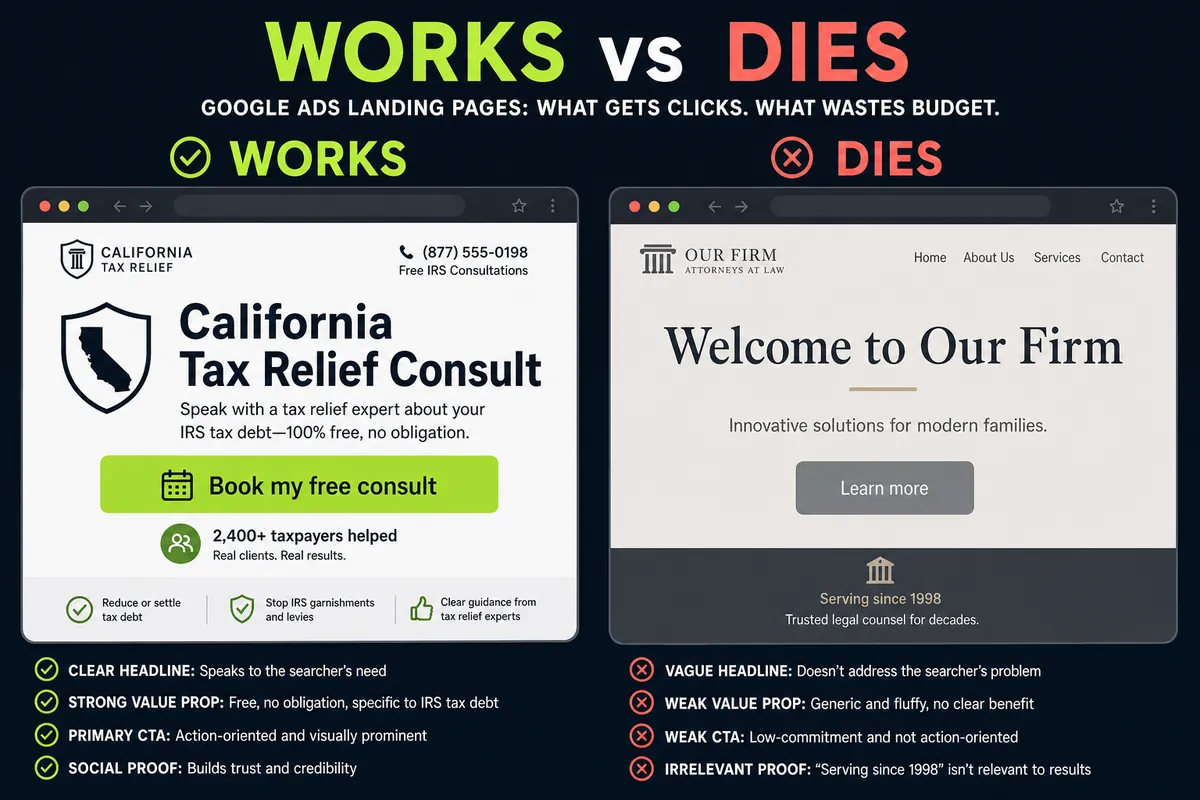
Works — keep the budget here
Dies — this is where spend disappears
If your first screen looks like the “dies” column, you’re training Smart Bidding that paid Search doesn’t convert — then wondering why CPLs climb. Landing page conversion starts before the form: the visitor has to recognize the ad promise in under two seconds.
Clear headline speaks to the searcher’s need. Strong value prop is free/no-obligation or outcome-specific — not fluff. Primary CTA is action-oriented and visually loud. Social proof is relevant to the offer, not “serving since 1998” in the footer.
Split pages when one headline can’t cover both intents. Don’t spawn twenty near-duplicate city pages unless local proof actually changes conversion rate. More URLs without more message match is just more places for Quality Score to suffer.
Slow pages tax Quality Score — and patience.
Thank-you fires once. No signal, no Smart Bidding.
New page when one headline can’t cover both offers.
Need the annotated anatomy of a converting page? Read landing page for Google Ads — anatomy. Or take the Ads Eye Challenge — eight taps, instant feedback.
Landing page conversion isn’t a footer redesign project. Visitors decide in seconds whether the Google Ads landing page matches the ad. If the H1 is vague and the CTA says “Learn more,” you paid for a bounce.
Use the works-vs-dies visual as a gut check on every new URL: clear headline, strong value prop, primary CTA, relevant proof. If any of those fail, fix the page before you scale bids.
Split when one headline can’t cover both intents. Don’t spawn twenty near-duplicate city pages unless local proof actually changes conversion rate. More URLs without more message match is just more places for Quality Score to suffer.
A converting Google Ads landing page still fails if thank-you tags double-fire or spam forms sit in Primary. Pair this guide with conversion tracking hygiene and Search structure so Smart Bidding learns from real leads — not brochure vanity.
Pair pages with clean Google Ads conversion tracking and landing pages & tracking services. Train your eye in the Ads Eye Challenge.
Email the offer, market, and monthly Search spend — or take the Ads Eye challenge to spot weak first screens fast.